Empower Your Business with AI Automation & Governance Readiness
Exceel Automation is an AI consulting & Governance Assurance Awareness partner helping SMEs and mid-market organisations to assess and implement AI systems safely ready for ISO/IEC 42001 Regulation.
(We are not ISO certified audit regulators. We simply guide you in becoming AI ready and compliant)
We assess where opportunities may be being lost from missed calls, slow response times and weak follow-ups to inefficient workflows, customer experience gaps and competitor positioning.
Alongside automation and AI implementation, we also provide AI governance consulting to help businesses understand how AI is being used, where risks may exist, and what policies, responsibilities and safeguards should be in place.
Our focus is simple: help you improve efficiency, protect your business, create better customer experiences, and make smarter use of AI and automation within your organisation.
SOC2 compliance / GDPR
Apps & Websites
We build customised apps and websites designed around the way your business actually works — helping you improve customer experience, simplify processes, generate leads, and turn ideas into practical digital solutions.
Whether you need a professional business website, customer portal, internal tool, booking system, lead management app, or a completely bespoke solution, we can help take it from concept to launch.
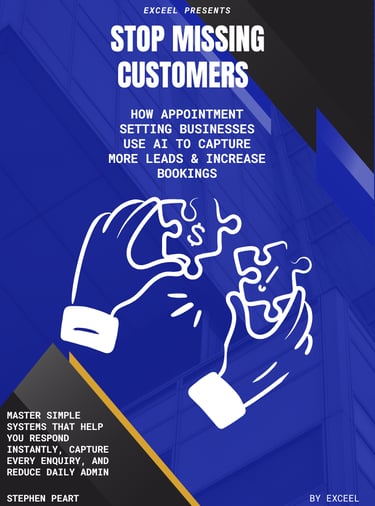
ebook $37
Capture Every Customer Enquiry, Never Miss an Opportunity Again Using AI Automations
What You Get
Ebook: Stop Missing Customers (problem & solution)
50 Done For You AI Prompts
Copy/paste Script Template Library
AI Systems Platform Overview
Bonus - AI Personal Assistant (Custom GPT within ChatGPT) and more
24/7 Customer Support
For chatbots:
Are customers waiting too long for answers to simple questions?
Could a chatbot help you respond to customer enquiries instantly, even outside working hours?
How many enquiries are you missing because no one is available to reply straight away?
Could common customer questions be handled automatically before they reach your team?
Would it help if customers could get answers, book appointments, or leave details without waiting?
For voice receptionists:
How many calls could your business be missing when no one is available to answer?
Could an AI voice receptionist help you answer calls 24/7?
Are missed calls turning into missed customers?
Would it help if calls could be answered, qualified, and routed automatically?
Could a voice receptionist reduce interruptions while making sure every caller gets a response?
Bleeding revenue from missed calls?
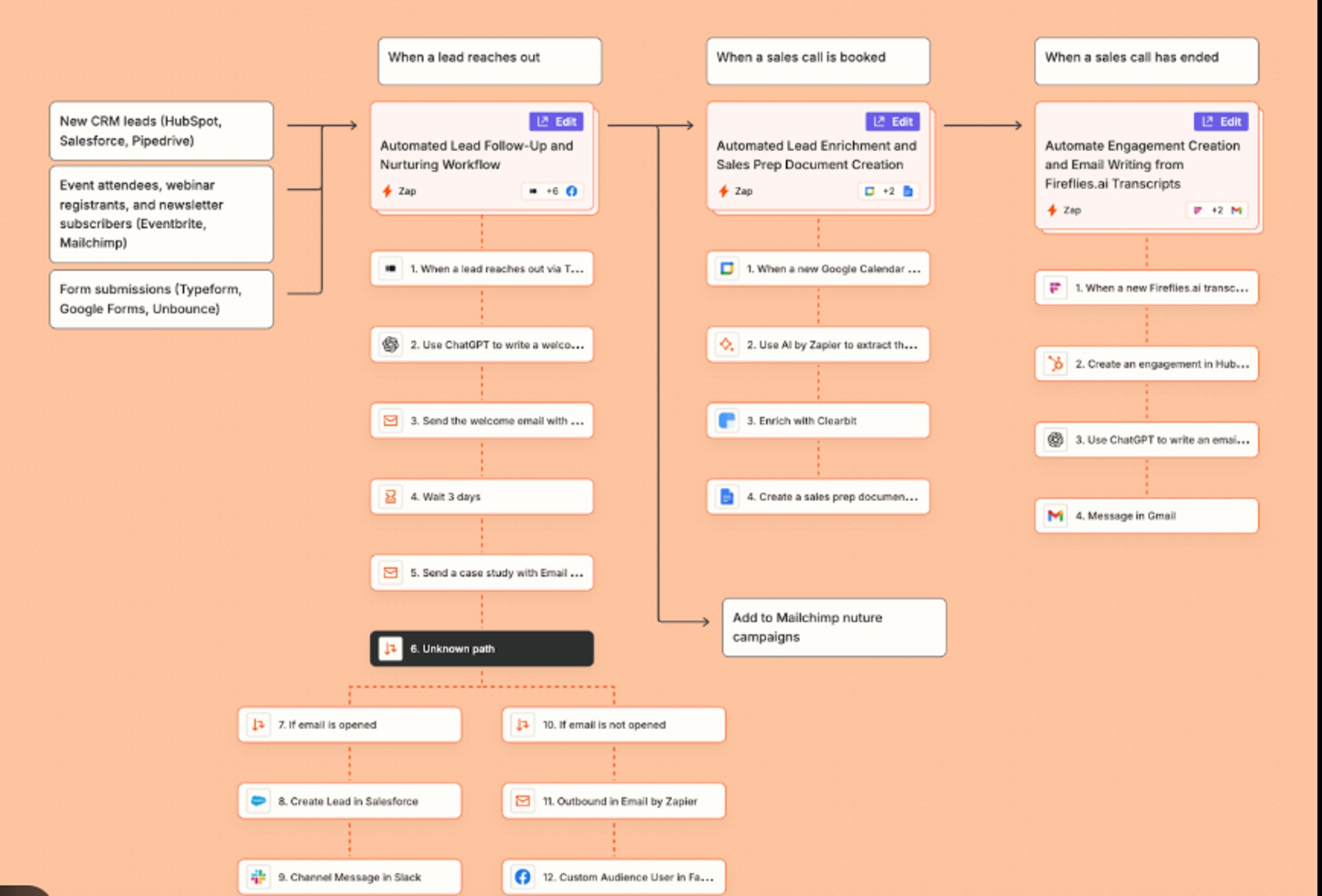
This ebook hands you the exact AI playbook to deploy chatbots, voice receptionists, and workflow automations that capture every lead, 24/7.
You also get a battle-tested prompt library, copy-and-paste prompts for competitor analysis, marketing, sales, forecasting, and email script producing.
Bonus - Custom GPT Personal Assistant ready-to-use.
Zapier and Make automation platform plug and play prompts if wish to experiment building workflows for yourself.
This is a mini course in itself as well as the shortcut to turning your business into a missed-call-proof, AI-powered machine that sells while you sleep.
Workflow Automation
Are repetitive admin tasks taking up too much of your time?
Could parts of your day-to-day workflow be automated to save you time?
How much time does your team spend on repetitive admin and manual tasks?
Are there repetitive tasks in your business that could be handled automatically?
Could workflow automation help reduce admin and free up your team for more important work?
What repetitive tasks are slowing your business down?
AI Governance & Assurance Ready
Why are you using/thinking of using AI?
What AI are you using/thinking of using?
Who owns it?
What could go wrong?
What controls do you have?
How do you monitor it?Where is AI already being used?
What data is being exposed to it?
What decisions is it influencing?
What level of risk does each use case create?
Who owns that risk?
How do we know the AI is still performing appropriately?
Governance shouldn't stop AI adoption. Good governance makes AI adoption possible. Use AI where it creates value, control it where it creates risk, and always know who is accountable.
Assessing Your Business For AI & Governance Readiness
Whether you have an existing AI system in place or looking to implement one, our assessment services begin with a deep-dive strategic information gathering approach to define revenue or potential revenue leaks and requirements in your business concluding with a high spec recommendation and solution diagnostic report.
A typical structure consists of:
Missed enquiry review risk
Website and response speed review
Customer journey review
Lead follow-up review
Admin task review
AI Governance & assurance review
Competitor analysis review
AI opportunity road map
ROI estimate
Implementation plan
Pricing dependant on size of company
Most owners walk away with 2-3 things they can fix immediately.
Governance & Awareness Assessment
Responsible AI Starts With Three Questions
How Should We Use AI?
AI should be used as an assistant with controls proportionate to the consequences of the task.
For low-risk activities such as drafting content, summarising information or supporting research, light-touch governance may be enough. But where AI influences important decisions involving customers, employees, finance, education, healthcare or legal outcomes, stronger controls and human oversight are essential.
The key question is not simply, “Can AI do this?” but “Should AI be doing this, and under what controls?”
What Are the Risks?
AI can create significant value, but it also introduces risks that organisations need to understand and manage. These include:
Incorrect outputs, bias, privacy breaches, security vulnerabilities, over-reliance, lack of transparency and misuse.
The level of risk depends heavily on the use case. An inaccurate marketing draft may be inconvenient. An inaccurate AI recommendation affecting recruitment, lending or healthcare could have serious consequences.
Effective governance means identifying these risks early, assessing their potential impact and putting appropriate safeguards in place before problems occur.
Who Is Responsible?
AI does not remove human accountability.
Whether an organisation develops its own AI system or uses technology supplied by a third party, there must be clear ownership for how that AI is selected, deployed, used and monitored.
Boards, managers, technical teams, compliance functions and employees may all have different responsibilities, but accountability must never become unclear.
AI can support the decision. Humans and organisations remain responsible for the outcome.